 The Queen
Probiotics. Do these little organisms really help your heart health, or is that all hype?
What is gut health, and is it really linked to other organs? Or is that also a lot of hype?
Let’s unpack this.
What Are Probiotics?
While gut health, the microbiome, and probiotics in particular feel like relatively new health concepts (as I write this, WordPress doesn’t recognize microbiome or probiotic as actual words), this terminology is not new to the medical science community.
Probiotics are microorganisms first discovered in the early 1900’s, when Russian Nobel Laureate Élie Metchnikoff started looking into the Bulgarian peasant population, which lived longer than most people. What he discovered is that these people drank a fermented yogurt drink on a daily basis.
Metchnikoff found this drink contained a probiotic called Lactobacillus bulgaricus, which he hypothesized improved the health of the Bulgarians, resulting in an increased lifespan.
At the time, this was a big deal. Other life-lengthening remedies – like swallowing gold – were expensive. Yogurt was affordable. And accessible. And it became a very popular fountain-of-youth for the masses, especially after Metchnikoff won the nobel prize (not for this particular discovery, but for his studies on the immune system).
Then, Metchnikoff died at the age of 71, and the hysteria surrounding his fame died with him. At a relatively young age.
In 1919, a company in Barcelona, Spain called Danone (which would later be branded as Dannon in the U.S.) started marketing yogurt as a medicinal remedy for intestinal issues. In the 1960s, the U.S. saw a rise in sales. But, for the most part, yogurt was looked at as a dietary fad.
In the past decade or so, however, there’s been more scientific research related to the health effects of probiotics.
The Science Behind Probiotics
In 2014, the American Heart Association reviewed nine different studies and determined that probiotics could lower your blood pressure.
In 2018, the BMJ reported that probiotics taken during pregnancy might help lower the risks of pre-eclampsia and premature birth.
More recently, the University of Cincinnati has reported using probiotics to break down the walls of cancer cells, making the cell more receptive to medical treatment.
My Results – THE LOWEST SO FAR
In the month of October, my average blood pressure fell to 126/80, with a resting heart rate of 71. This is the lowest rate I’ve achieved so far.
What I found really interesting was the Diastolic pressure (the amount of pressure in the arteries when the heart rests between beats) dropped 9 millimeters of mercury (mm Hg) for the month. NINE! This is the most significant monthly decrease I’ve seen in my diastolic reading since January when we started practicing yoga three times per week. Overall, my diastolic pressure is down by a stunning 25 mm Hg since the start of this experiment.
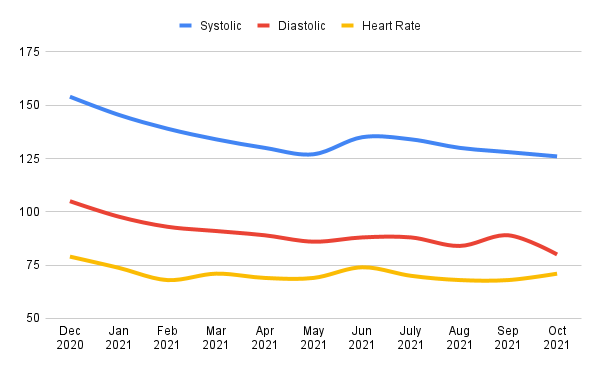
My Systolic pressure (the amount of pressure in the arteries during the contraction of your heart muscle) came down by 2 millimeters of mercury (mm Hg) during the month of October, and is down a whopping 28 mm Hg since December 2020.
My heart rate (the number of times the heart beats per minute while at rest) was up by 3 bpm in October but is 8 bpm under the December 2020 average.
While I haven’t met any new goals, I am still in Stage 1 Hypertension, according to the American Heart Association recommendations. When I started this experiment, I was in Stage 2. My goal is to get to Normal by the end of the year. And I”M SO CLOSE! I just need to get my Diastolic pressure under 80 and I’ll be there. I’ll be NORMAL.
Let’s go holiday season! Think I can lower my blood pressure during this time of the year?
One Reply to “Probiotics: Key to Improved Blood Pressure Results”
Comments are closed.