 The Queen
I spent a year experimenting with ways to lower my blood pressure through habit formation.
In 2021, I lowered my blood pressure from an average of about 155/100 to an average of about 125/75, without the use of medication. This is how I did that.
First: I’m not a doctor or a nutritionist. So please don’t take this as medical advice. I’m just telling you my story. Please talk to your own doctor before making any big changes to your life, especially going off your blood pressure medication.
My History with High Blood Pressure
In 2019, I started seeing a cardiologist. You can read about the full history of that here if you’re interested.
After conducting a bunch of tests, my doctors put me on a low dose of a diuretic, which is a common blood pressure medication. And I got mixed results from it. It lowered my blood pressure a bit, but not enough, and even small doses started to affect my periods.
It made my flow heavier and my cramps more painful and cut my cycle by about three days. And I learned a long time ago that anything that messes with my period is a red flag. So I talked to my doctor about it and he said there was nothing he could do for me except 1) continue to up the dosage on the pharmaceuticals he prescribed until my blood pressure dropped to an acceptable level and 2) someday, probably, have surgery. Because that’s the direction this typically goes.
This is how the western medical model functions and that works great for most people. But for me, I wanted a preventative solution that wasn’t going to mess with my periods. So I knew I was going to have to modify my lifestyle, and make changes to improve my health.
How To Achieve Lower Blood Pressure?
Admittedly, I’m a research nerd. So the first thing I do when I have a problem is find answers in the form of data. From reputable sources. That’s the key. But the basis of the advice I found boiled down to three things:
- Lose Weight
- Reduce Stress
- Get Better Sleep
If you’re here, I’m willing to bet you’ve heard this advice too. And I’m not saying it’s wrong. But. Allow me to suggest that reducing stress, losing weight and getting more sleep are not actionable goals, but rather the body’s reaction to behavior choices we make. You can’t just wake up one day and decide to do one of those things and then magically your decision creates results. That’s not reality.
What this all comes down to is habit formation.
But this is why your doctor is not generally making behavior recommendations:
“Many health professionals shy away from giving advice on modifying behaviour because they find traditional behaviour change strategies time-consuming to explain and difficult for the patient to implement.”
– British Journal of General Practice
A lot of people just want to take that prescription and go about their day. And that is fine. I pass no judgment on what you choose to do with your own body. You do you.
But for me, this wasn’t going to work. I couldn’t stand back and wait for the white-coated knight to save me. Whatever action I took had to be my own.
I had to save myself.
The Habits
What I needed was a plan with actionable goals. Little tasks I could perform everyday, in the pursuit of lower blood pressure. I used 12 controlled experiments, introducing a new independent variable every month of the year, building on those habits over time, and recording my blood pressure during each change, to track the results.
I was not perfect at any of it. That’s not how humans work. But every little goal I tried pushed me forward in some small way and, in the end, all these small changes added up to lower blood pressure.
To create a new habit, you have to:
1. Decide on a goal that you would like to achieve for your health.
2. Choose a simple action that will get you towards your goal which you can do on a daily basis.
3. Plan when and where you will do your chosen action. Be consistent: choose a time and place that you encounter every day of the week.
4. Every time you encounter that time and place, do the action.
5. It will get easier with time, and within 10 weeks you should find you are doing it automatically without even having to think about it.
6. Congratulations, you’ve made a healthy habit!
– British Journal of General Practice
Today I’m going to touch on some of the habits I implemented in 2021. I’m not going to go into too much detail because there are 12 of them, so that would be a very long post. If you’d like to hear more, however, I did chronicle my entire journey throughout 2021, and you can link to the results I tracked along the way for each month through this post, if you’re interested.
This summary will be broken up into two parts. Today we’ll talk about the first six habits I developed, and next week, I’ll follow up with the last six.
Habit #1: Practice yoga three times per week
In January, I started with a regular yoga practice. I set an alarm on my phone for 5 pm on Mondays, Wednesdays and Fridays. I work from home and it gets easy to continue working past that 5 o’clock mark if you allow that. Setting my alarm for 5 pm helped me stop working at a healthy time and also prompted me to workout.
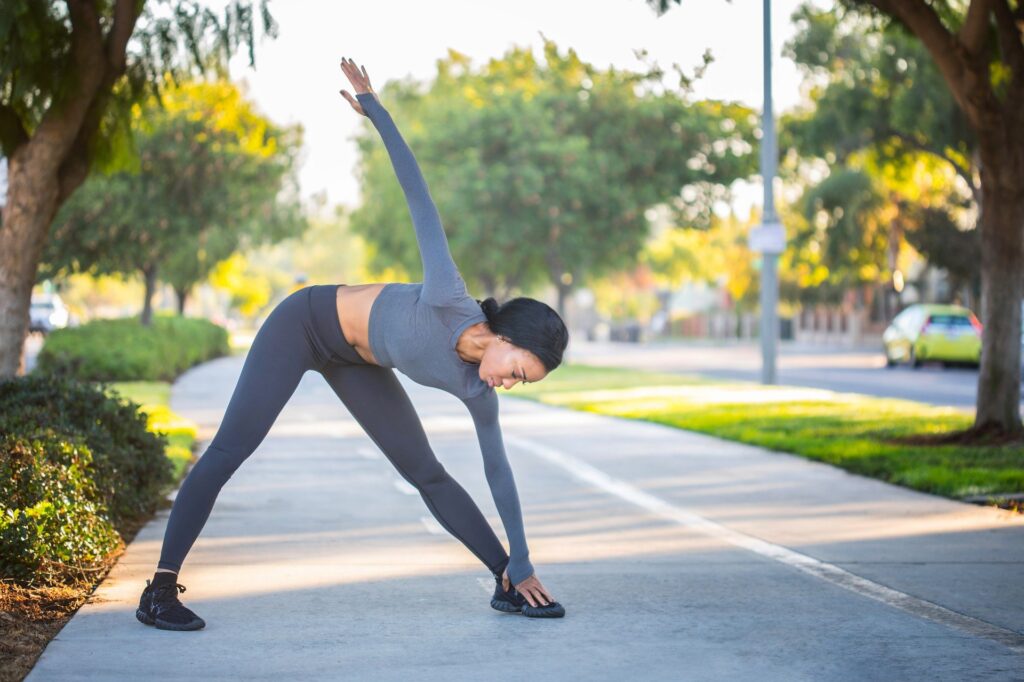
I asked my husband to do this with me and we used the DDPY yoga program, which was created by former wrestler Diamond Dallas Page. He’s tried to make yoga feel more accessible for men, which I love. It was a great program and we both enjoyed it.
I’m really glad I started with yoga in January, because I was able to see results right away, and that was motivating. My blood pressure came down significantly in January. In fact, throughout the entire year, this was the month I saw the steepest decline in my systolic pressure, the top number in the reading, which is the amount of pressure in the arteries during the contraction of the heart muscle.
Habit #2: Cut out refined sugar
I have talked a lot about not depriving yourself of anything. But one of the things my doctor mentioned is that sugar, not salt, is the real enemy of the heart.
So I pulled everything out of the pantry and the fridge and read every label. And you would be shocked at the amount of things that have sugar in them. It’s crazy. Not just standard boxed processed foods. Things like vanilla. Sometimes your bottle of vanilla can have sugar in it. I could not believe that.
And honestly, it was not that hard. Once I’d gotten rid of everything in the house that had sugar in it, and I found a few recipes for sweet treats made with maple syrup or honey, we were fine. I wrote about that process in the Seven Secrets to Survive without Sugar.
February resulted in another deep decline in my blood pressure. And, out of all the months of the year, this was the month that my heart rate dropped the most, which I found interesting.
Also – I should mention that I was still doing yoga three days a week. Each month, I didn’t stop doing the thing I’d implemented the month before, I just stacked these habits on top of each other so that by the end of the year, I was practicing all 12 simultaneously.
Habit #3: Meditate three times per week
Meditation is one of the hardest things for me. I have always functioned under a “get it done” mentality. Meaning if I’m feeling stressed, I organize a bookshelf or clean a room in my house, or go for a walk, or call a friend. My defense mechanism is acting on something. I have a hard time sitting and just being.
So I knew Meditation March was going to be difficult for me.

To help myself create this habit, I set an alarm on my phone, three days a week, at noon. So I now have a three-days-a-week alarm for yoga at 5 pm and a three-days-a-week alarm for meditation at noon. I have two meditation apps on my phone. One is the Calm app and another is the Harmony app. The Harmony app uses hypnotism, while the Calm app uses stories. And I like both.
In March I saw my blood pressure decline again, although my heart rate actually went up a bit, which I thought was interesting. And more excitingly, I met my first small goal. I lowered my blood pressure to the same level it was at when I was taking 20 mg of the diuretic medication.
I had done that in just three months. So I knew I was on the right track.
So those first three habits, yoga, cutting out sugar and meditation, I consider the three pillars of this experiment. With yoga, I saw the deepest drop in my systolic pressure all year, with cutting out sugar I saw the deepest drop in my heart rate all year – it will be a few months before I see the year’s deepest drop in diastolic pressure, so stay tuned for that. And with meditation, or likely, all three of those things combined, I met my first small goal of lowering my blood pressure readings to match the effects of my prescription medication without the side effects.
This was very motivating. And from here on out, all the goals are smaller, less life changing, more adjustments if you will. But I will note that each of them helped in at least a very small way.
Habit #4: Drink tea three times per week
At this point, the power of three was working well for me. So when I read a new study that was released, confirming the long-held beliefs that tea has some impressive heart-healthy benefits, I thought, that’s my next habit. I’ll drink tea three times per week.
This was actually harder than you might think. Again, remember, I have trouble with relaxing. Having a cup of tea feels very unnecessary to my life. So, this was actually hard for me.
Again, I set an alarm on my phone. At 3 pm. Three times a week. And when this alarm would go off, I’d forced myself to stop working and take a tea break. And eventually, I grew to crave this time because it started to feel very nice.
I met another goal in April. I officially fell out of Stage 2 Hypertension. If you haven’t seen this chart (below) from the American Heart Association, it’s a great way to gauge progress, It lays out the stages of hypertension, in order to illustrate just how much danger your heart is in, depending on the category in which you rank.

At the beginning of 2021, I was in Stage 2 Hypertension, and as of the end of April, I had fallen into the Stage 1 Hypertension designation. I was very happy with that progress. And again, it gave me the motivation to keep going.
Habit #5: Eat salmon once per week
In May I decided to add some Omega-3 fatty acids to my diet on a regular basis. Salmon contains long-chain omega-3 fatty acids, which can lower blood pressure and strengthen the immune system. And yet, a study conducted by Harvard’s T.H. Chan School of Public Health concluded that only “About one-third of Americans eat seafood once a week, while nearly half eat fish only occasionally or not at all.”
And I was in that group. I always considered seafood to be special occasion food and I didn’t like cooking it at home.
So in May, I decided to step up my Omega-3 game and try various recipes and incorporate this into my regular meal plan.

For this experiment I recreated dishes I’d loved in restaurants, I experimented with salmon cakes and fresh and canned salmon. Sometimes I just made salmon salad and ate it with crackers. I tried to demystify the experience.
As a result, I managed to meet another small goal in May. My blood pressure fell to the same levels as what it was seeing when I was taking 50 mg of the diuretic. This was significant because I never went higher than 50 mg on the medication. By that time, I was reacting negatively to the medication and knew I needed to find another path.
So, here we are in May, five months in, and I’ve achieved what I set out to achieve, which was to impact my blood pressure in the same way as the medication, without the side effects.
Habit #6: Take a break
At the beginning of June, I was feeling some burnout. I had been committed to this experience for five months now and I felt like I needed a break.
But I ignored it. Then I sprained my ankle.
If you’ve ever sprained your ankle, you know this is debilitating. There’s no treatment, except to relax and let it heal. Which means SEVERAL WEEKS of time off from working out. I had planned to start working out two additional days per week in June, taking my total to five days per week.
I fought this for a bit, trying to do yoga in the bed or a chair.
Then my eleven-year-old was bit by a dog.
And I had to consider the possibility that the universe was trying to tell me something.
So, I gave in, I listened. And I took a break.
In the month of June my blood pressure went up. Not by a lot, but I’d been making small strides of progress and now, I was going backwards.
Stress clearly impacts my blood pressure results. But that’s okay. The lesson here is, sometimes we just need a break. Sometimes, life gets in the way of our goals. And challenges our commitment to them. It’s in those moments that we really find out who we are. Are we going to let the challenges of life stop us? Or are we going to take a break, breathe a little, feel our feelings, and then keep moving forward on the other side of the problem?
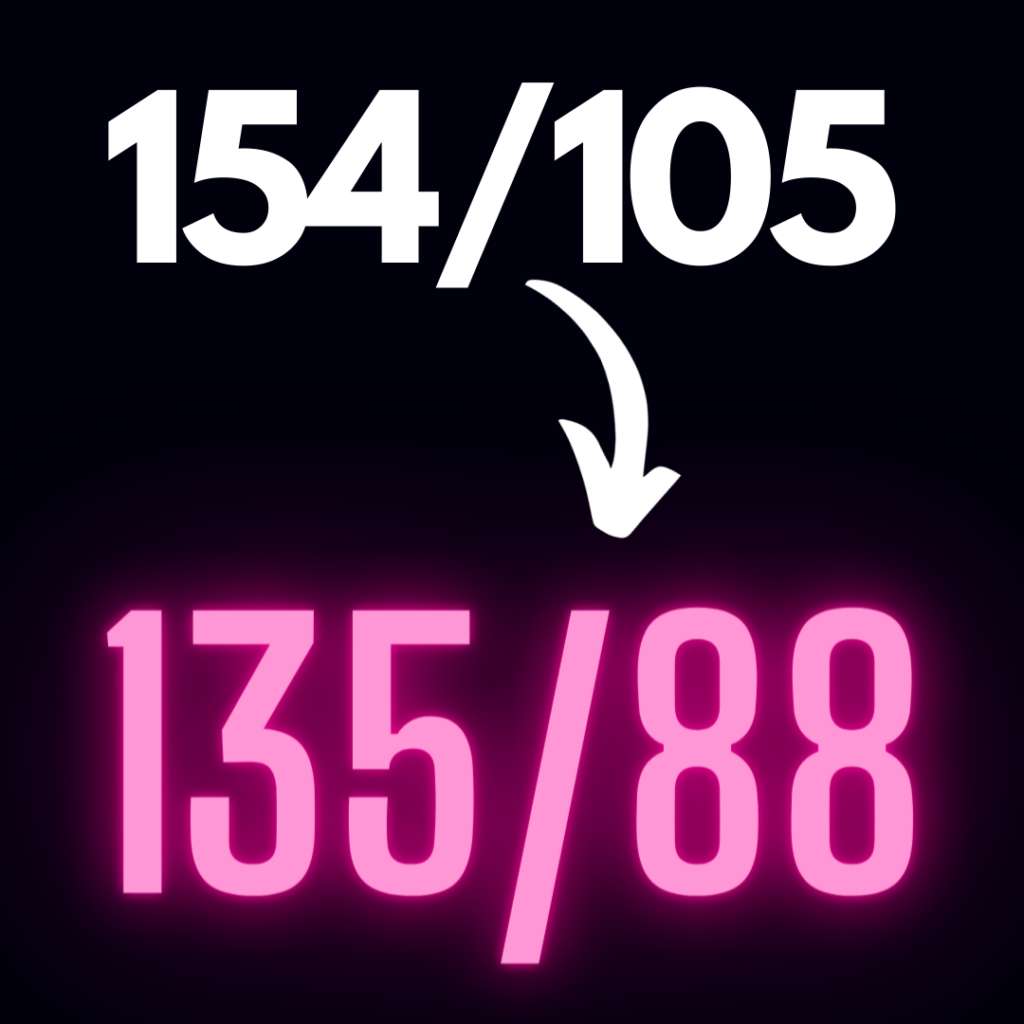
At the end of six months, I had lowered my blood pressure from an average of 154/105 to 135/88. It was not where it needed to be just yet. But I had six more months – and six more goals – to go.
Next week, we cover part two, including the end-of-year results, which are awesome.